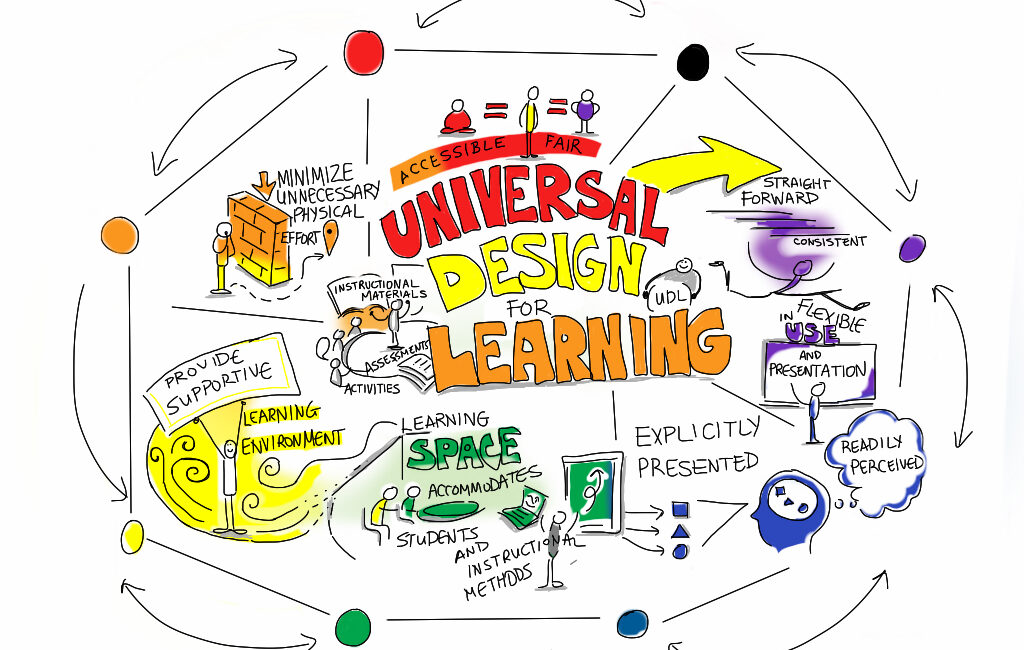
Last semester I took a course where everything was done one way. You read the textbook, you write the essay, you submit it. That’s it. No options, no flexibility, nothing. And honestly for a while I just thought that was normal — that’s just how school works right?
But after reading about Universal Design for Learning this week it hit me — that course wasn’t designed for me. It was designed for some imaginary “average” student who loves reading dense textbooks and is great at writing long essays. CAST (2018) basically says there is no average learner, everyone learns differently, and designing for one type of person automatically puts everyone else at a disadvantage.
What UDL actually means
UDL has three main principles — giving learners multiple ways to receive information (representation), multiple ways to show what they know (action and expression), and multiple ways to stay motivated (engagement). That course had basically none of these.
Like for representation — everything was just readings. No videos, no diagrams, nothing visual. Some people just don’t learn well from walls of text and that’s not their fault, it’s just how they’re wired. A short video or a simple diagram alongside the reading would have made a huge difference for a lot of people.
For expression — why is an essay the only way to prove you understand something? Some people are way better at explaining things out loud or visually. The goal is to show understanding, not to prove you can write a 5 paragraph essay.
And engagement — there was zero flexibility. Bad week? Tough. Had an exam in another class? Not my problem. It reminded me a lot of 75 Hard actually one size fits all, no exceptions, and if you can’t keep up then that’s on you. But that’s not good design, that’s just pressure.
How this connects to what we’re building
For our password security resource, our audience is mostly non-technical people. If we design it like that course — one format, one way to engage — we’re going to lose half our learners before they even get to the good stuff. So we’re trying to keep the language simple, give people hands-on activities like the CrackStation challenge, and make sure there’s always enough context that you don’t need a CS degree to follow along. That’s what the Inclusive Design Research Centre (n.d.) talks about too — inclusion has to be built in from the start, not added as an afterthought.
References
CAST. (2018). Universal design for learning guidelines version 2.2. http://udlguidelines.cast.org
Inclusive Design Research Centre. (n.d.). Inclusive design guide. https://guide.inclusivedesign.ca/